Availability: Low stock: 80 left
Couldn't load pickup availability
Once you receive your order confirmation email, your order will be processed within 2–3 business days (excluding weekends and public holidays).
Installation must be carried out by a qualified electrician.
Ensure power is switched off before installation.
Suitable for indoor use.
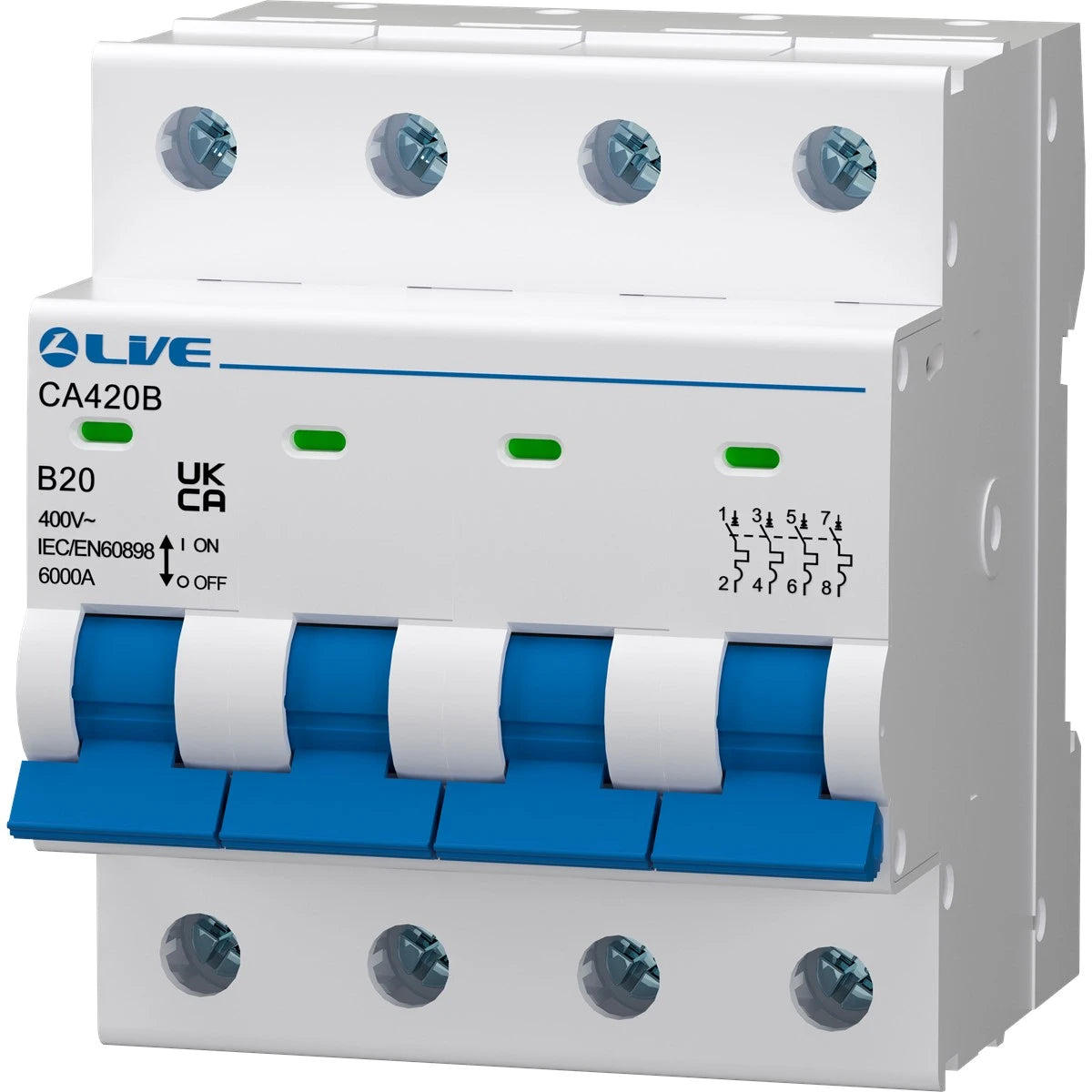
The Live CA420C 4 Pole MCB is a robust industrial-grade miniature circuit breaker engineered to provide comprehensive protection for three-phase systems requiring simultaneous neutral conductor switching in applications with significant inductive loads. Rated at 20 Amps with a C-curve tripping characteristic, this 4-pole breaker safeguards all three phases and the neutral conductor on AC systems up to 400V at 50/60Hz frequency. It delivers reliable protection against overloads and short circuits, making it the ideal choice for industrial motor circuits, pumps, compressors, machine tools, and commercial applications where moderate to heavy inductive loads combine with the need for complete isolation of all conductors. With a substantial 6kA breaking capacity and precision thermo-magnetic release, the CA420C ensures equipment protection and operational safety in demanding industrial environments.
Complete 4-Pole Industrial Protection: Simultaneously protects and switches all three phases (L1, L2, L3) and the neutral (N) conductor, ensuring complete circuit isolation during fault conditions and maintenance for industrial applications with significant inductive loads.
Heavy-Duty C-Curve Characteristic: Trips instantaneously at 5-10 times the rated current (100A to 200A), specifically calibrated to handle substantial inductive loads including motors, pumps, compressors, and transformers with significant inrush currents.
Ideal Industrial Motor Protection Rating: 20A per pole provides the perfect capacity for industrial motors up to 7.5kW (10HP), pumps, compressors, and heavy machinery requiring neutral switching.
Integrated Neutral Switching: Neutral pole ensures the neutral conductor is disconnected simultaneously with phases, preventing floating neutral conditions and ensuring complete safety during equipment maintenance in industrial settings.
Reliable Breaking Capacity: Certified 6kA rating ensures safe interruption of fault currents, protecting expensive industrial equipment and ensuring personnel safety.
Precision Thermo-Magnetic Release: Combines thermal bimetal strip for accurate time-delayed overload protection and magnetic solenoid for instantaneous short-circuit response across all four poles.
Superior Electrical Isolation: With 4000V impulse withstand rating and 500V insulation voltage, providing excellent protection against voltage transients and power surges in industrial environments.
Extended Operational Life: Engineered for 8,000 electrical operations, ensuring long-term reliability in industrial applications with frequent switching and demanding duty cycles.
Professional Installation: Standard DIN-rail mounting with IP20 finger-safe terminals and 16mm² wiring capacity for secure panel integration in industrial environments.
| Specification | Details |
|---|---|
| Brand | Live |
| Model Number | CA420C |
| Device Type | Miniature Circuit Breaker (MCB) |
| Pole Configuration | 4 Pole (3P + N) |
| Current Rating (In) | 20 Amperes |
| Trip Curve Type | C Curve (5-10 × In) |
| Operational Voltage | 230/400V AC |
| Frequency Range | 50/60 Hertz |
| Short-Circuit Capacity | 6kA (6000 Amps) |
| Insulation Rating (Ui) | 500 Volts |
| Impulse Withstand (Uimp) | 4000 Volts (1.2/50 µs) |
| Dielectric Test Voltage | 2kV for 60 seconds |
| Protection Mechanism | Thermo-magnetic (all poles) |
| Neutral Pole Protection | Switched neutral (fully protected) |
| Operating Temperature | -5°C to +40°C (daily average ≤35°C) |
| Calibration Reference | 30°C |
| Storage Conditions | -25°C to +70°C |
| Electrical Lifespan | 8,000 cycles |
| Enclosure Protection | IP20 (finger-safe) |
| Terminal Capacity | Up to 16 mm² |
| Mounting Type | DIN Rail (35mm) |
| Certification Standard | IEC 60898-1 |
1. What are the primary applications for the Live CA420C 4 Pole 20A C-Curve MCB?
The CA420C 4-pole 20A C-Curve breaker is perfectly suited for a wide range of industrial and heavy commercial applications requiring neutral switching for significant inductive loads. Ideal applications include:
Industrial motor protection (up to 7.5kW/10HP)
Pump systems (centrifugal pumps, borewell pumps, irrigation pumps)
Air compressors for industrial use
HVAC systems and large commercial refrigeration units
Machine tools (lathes, milling machines, grinders, drill presses)
Conveyor systems and material handling equipment
Industrial washing and processing equipment
Large ventilation systems and industrial exhaust fans
Compressors for refrigeration and air conditioning
Three-phase socket outlets in industrial workshops requiring neutral switching
Small industrial production machinery
Circuits in IT earthing systems requiring complete isolation
Commercial kitchens with heavy motorized equipment
2. Why choose a 20A C-Curve 4-pole MCB for industrial motor applications?
Industrial motor applications have specific requirements that make the CA420C ideally suited:
C-Curve tolerance: Industrial motors (up to 7.5kW/10HP) typically draw 5-8 times their full-load current during startup. The C-Curve (5-10x In) allows startup surges up to 200A without nuisance tripping while maintaining fault protection.
Perfect power level: 20A at 400V provides approximately 13.8kW of three-phase power, ideal for most small to medium industrial equipment.
Complete isolation: 4-pole switching ensures all conductors including neutral are de-energized during maintenance, critical for technician safety in industrial environments where equipment may have multiple power sources.
Neutral switching essential: Many industrial control systems, VFDs, and CNC machines require neutral disconnection for complete isolation and compliance with safety standards like IEC 60204.
Fault discrimination: Proper coordination with downstream motor protection, contactors, and overload relays.
Versatility: Suitable for various starting methods including DOL, star-delta, and soft-starter applications for motors up to 7.5kW.
3. What is the motor power capacity of this 20A 4-pole MCB for different starting methods?
For a standard 400V three-phase system with 4-pole protection, the CA420C 20A can handle various motor configurations:
Direct-On-Line (DOL) Starting:
Induction motors: Up to 5.5kW (7.5HP) for standard efficiency motors
Typical starting current: 6-8 × full load current (120A to 160A), within C-Curve tolerance up to 200A
Locked rotor current: Must not exceed 200A (10 × In) for reliable operation without magnetic tripping
Star-Delta Starting:
Induction motors: Up to 7.5kW (10HP) due to reduced starting current (approximately 3-4 × FLC)
Starting current: Approximately 60A to 80A, well within C-Curve limits
Transition current: Ensure star-delta transition doesn't cause current spikes exceeding magnetic trip threshold
Soft-Starter or VFD:
Induction motors: Up to 9kW (12HP) with properly configured soft starting
Starting current: Can be limited to 2-3 × FLC (40A to 60A)
VFD considerations: Ensure VFD input current doesn't exceed 20A continuous rating
Maximum three-phase resistive load: P = √3 × V × I = 1.732 × 400V × 20A = 13.86 kW
For continuous motor operation (80% rule): Maximum continuous motor current should not exceed 16A, equating to approximately:
5.5kW (7.5HP) for DOL start motors
7.5kW (10HP) for star-delta or soft-started motors
Always verify motor nameplate data, starting method, starting current characteristics, and duty cycle for accurate sizing.
4. When is 4-pole C-Curve protection essential for industrial applications?
Four-pole C-Curve protection with breakers like the CA420C is essential or strongly recommended in specific industrial scenarios:
IT earthing systems: Common in industrial facilities, mines, and hospitals where the neutral is not directly earthed, requiring complete isolation of all conductors for safety.
Equipment with VFDs and soft-starters: Most variable frequency drives and soft starters require neutral disconnection for complete isolation during maintenance as per manufacturer specifications.
CNC machines and robotics: Modern CNC equipment often has multiple power supplies and requires complete isolation of all conductors for safe maintenance.
International equipment specifications: Machinery exported to countries (e.g., Japan, some European countries) requiring 4-pole isolation per local regulations.
Generator-fed industrial systems: Where neutral switching is required to prevent circulating currents between mains and generator supplies, especially in standby power applications.
Industrial panels with mixed voltage systems: Where clear isolation of all conductors simplifies troubleshooting and maintenance in complex control panels.
Chemical and pharmaceutical plants: Where safety regulations mandate complete isolation during maintenance in hazardous areas (Zone classification).
Food processing equipment: Where washdown procedures require complete isolation of all electrical supplies for operator safety.
When specified by equipment manufacturers: Many industrial machinery OEMs require 4-pole isolation for warranty and safety compliance.
Mining and heavy industry: Where robust isolation practices are required by safety codes due to harsh environments.
Upgrade projects: When upgrading industrial facilities from TN-C to TN-S systems, 4-pole switching is required at the transition point.
Marine and offshore installations: Where specific regulations require 4-pole switching for safety in marine environments (IEC 60092 series).
5. What are the cable sizing and installation recommendations for industrial 20A 4-pole circuits?
For a 20A 4-pole MCB in industrial applications with inductive loads, proper installation ensures reliability, safety, and compliance with industrial standards:
Cable Sizing:
Standard copper conductor: 4 mm² is recommended for 20A industrial circuits
Minimum acceptable: 2.5 mm² for very short, protected runs, but 4 mm² is preferred for mechanical robustness
The CA420C terminals accept cables up to 16 mm², offering flexibility for various wiring scenarios
Voltage drop considerations for 20A motor circuits:
4mm²: Suitable for runs up to 25-30 meters
6mm²: Recommended for longer runs up to 40-45 meters
10mm²: For extended runs over 50 meters or where voltage drop is critical for motor starting torque
Neutral conductor: Must be the same size as phase conductors for 4-pole circuits; consider oversized neutral if significant harmonics from VFDs are present
Industrial Installation Best Practices:
Wire ferrules: Use insulated ferrules on stranded conductors for reliable termination, essential in vibration-prone industrial environments
Torque settings: Follow manufacturer specifications for terminal tightening (typically 2.5-3.5 Nm); use torque wrench for consistency on critical circuits
DIN-rail mounting: Ensure secure mounting on standard 35mm DIN rail with appropriate end anchors; consider anti-vibration mounts in high-vibration areas
Cable identification: Properly label all phase (L1, L2, L3) and neutral (N) conductors with durable industrial-grade markers; use heat-shrink labels for longevity
Segregation: Maintain separation between power and control wiring to prevent electromagnetic interference, especially with VFD cables
Ambient temperature: Consider derating if multiple breakers are closely mounted in high-temperature industrial environments (boiler rooms, foundries)
Spare capacity: Leave spare ways for future equipment additions and modifications
Lockout provisions: Ensure lockout/tagout procedures can be implemented with appropriate hasps and padlocks for maintenance safety
Industrial Specific Considerations for Motor Circuits:
Motor circuit coordination: Ensure breaker coordinates with motor starter, overload relay, and contactor for Type 1 or Type 2 coordination as required
Short-circuit ratings: Verify that all downstream components have adequate short-circuit ratings with 6kA available fault current
Cable type for motor circuits: Use flexible cables for connections to vibrating equipment; consider armored cables for mechanical protection
Thermal imaging: Regular thermal imaging of terminations in critical industrial installations is recommended, especially for heavily loaded circuits
Spare parts: Keep spare breakers for critical industrial applications to minimize downtime
Documentation: Maintain clear panel schedules, circuit identification, and as-built drawings for future modifications
Harmonic Considerations:
If supplying VFDs or other non-linear loads, neutral conductors may carry significant harmonic currents (especially triplen harmonics)
Consider oversizing neutral conductor (150% or 200% of phase conductors) if harmonic loads exceed 25% of total load
Consider harmonic filtering if neutral current is expected to be high
Compliance:
Always ensure installations comply with:
IEC 60204-1: Safety of machinery - electrical equipment
IEC 60364: Low-voltage electrical installations
IEC 60947-4-1: Contactors and motor starters
NFPA 79: Electrical standard for industrial machinery (for North American applications)
Local industrial electrical codes and regulations

